
A COMMUNICATION-ORIENTED INTERACTIVE AND INTEGRATED APPROACH.
Day-wise Lesson Plan:
Day 1
- Introduction to the English language.
- What is grammar and why it is important to learn grammar?
- What is a sentence?
- Types of sentences.
- Basic English Sentence Structure.
- The Concept of 1st, 2nd and 3rd Person in English Grammar.
- The 3rd person singular grammar in English.
- Dummy Subject – It & There.
Day 2 & 3
- Eight parts of speech in English.
- Why is it important to learn parts of speech?
- Noun – Proper & Common
- How to make plural nouns
- Collective Nouns
- Possessive Nouns
- Prefixes and Suffixes – An excellent way to build vocabulary.
- Compound Nouns
- Gerunds
- (1) Irregular plural nouns (2) Nouns with the same singular & plural forms (3) Uncountable nouns do not have plural forms (4) Nouns which are always plural.
Day 4 & 5
- Countable and Uncountable Noun.
- Why it is important to learn countable and uncountable nouns.
- Measure words for uncountable nouns.
- Usage of Some & Any.
- There is /There are - with countable nouns and uncountable nouns.
- Much, Many and Lots of with countable and uncountable nouns.
- Few, little, a few and a little with count and uncountable nouns.
Day 6 - Pronouns – Type of Pronouns.
- Personal Pronouns:
- (1) I, We, You, They, He, She and It. (Subjective Personal Pronouns)
- (2) Me, Us, You, Them, His, Her and It. (Objective Personal Pronouns)
Day 7 – Pronoun
- (1) Mine, Ours, Yours, His, Hers, Its and Theirs. (Possessive Pronouns)
- (2) This That These Those. (Demonstrative Pronouns)
Day 8 – Pronoun
- How to ask question using: Who, Whom, Whose, What, and Which as Interrogative Pronouns.
- How to join sentences using: Who, Whom, Whose, Which, and That as Relative Pronouns.
Day 9 – Pronoun
- Subject-verb agreement with indefinite pronouns.
- How to refer to people, things without saying exactly who or what they are: Some/any/every/no - body, - one, - thing, - where.
- How to use: Myself, yourself, himself, herself, itself, ourselves, yourselves, themselves. (Reflexive and Intensive Pronouns)
Day 10 & 11 - Adjective
- What are Adjectives?
- Describing someone’s personality & appearance.
- Adjective Suffixes & Oppositive Adjectives.
- Compound Adjectives.
Day 12 – Adjective - How to compare two or more than two things in English.
- What are syllables?
- Comparative & Superlative Adjectives.
- Irregular Adjectives in comparative and superlative forms.
- Quantifiers for comparatives.
Day 13 – Adjective
- Avoid using ‘Very’ to sound more powerful & interesting in English. (Extreme Adj)
- ED and ING Adjectives
Day 14/15 and 16 - Adverb
Learn how to add the following details to an action:How, When, Where, How often, and How much.
- What are adverbs?
- Difference between adverbs and adjectives.
- Types of Adverbs.
- Formation of Adverbs
- Adverbs of Manner.
- Adverbs of Frequency.
- Adverbs of Time.
- Adverbs of Place.
- Adverbs of Degree.
- Comparative & Superlative Adverbs.
Day 17
- The Three Basic Forms of English Verbs
- Regular verbs & ED spelling rules.
- Irregular Verbs
- Groups of similar patterns in irregular verbs – an easy way to memorize them.
Day 19, 20 & 21
Helping/Modal Verbs- What are three main functions of Do, Have and Be as helping verbs?
- Modal Verbs
- Modal verbs Group 1 - Obligation - Must, Should and Have to
- Modal Verbs Group 2 - Ability - Can and Could.
- Modal Verbs Group 3 - Asking and Giving Permission - May, Could and Can
- Modal Verbs Group 4 - How to use Will and Would
- Modal Verbs Group 5 - Could have, should have, would have, might have.
Day 22 & 24
- Action verbs: Transactive & Intransitive verbs.
- Subject-Verb Agreement.
- Verb prefixes and suffixes
- Phrasal Verbs.
Day 25, 26 & 27. - Present Simple Tense
- Present Simple Tense – Daily Routine
- Present Simple Tense – Daily Routine – 3rd person singular.
- Tense and aspect. (optional)
- The simple aspect. (optional)
- Formation of affirmative, negative, and interrogative sentences in the simple present tense.
- Signal words in the present simple tense.
- Usage of present simple tense.
- Speaking Practice in the present simple tense.
Day 28, 29 & 30. - Past Simple Tense
- What you did yesterday?
- Formation of affirmative, negative, and interrogative sentences in the simple past tense.
- Signal words in the simple past tense.
- Usage of simple past tense – usage.
- Simple Past VS Simple Present.
- Simple Past Tense – 2nd Conditional (optional)
- Speaking practice in the simple past tense.
Day 31, 32 & 33. - Present Continuous Tense
- The continuous aspect and continuous tenses.
- ING Spelling Rules
- Formation of affirmative, negative, and interrogative sentences in the present continuous tenses.
- Usage of present continuous tenses.
- Present simple and present continuous - COMPARISON.
- Speaking practice in the present continuous tense.
Day 34, 35 & 36. - Past Continuous Tense
- Formation of affirmative, negative, and interrogative sentences in the past continuous tenses.
- Usage of past continuous tenses.
- Past simple and past continuous COMBINATION.
- Speaking practice in the past continuous tense.
Day 37, 38 & 39. Simple Future Tense
- How to describe the future in English.
- Formation of affirmative, negative, and interrogative sentences in the simple future tense.
- Usage of simple future tense.
- When to use going to in the simple future tense.
- Many ways to talk about the future in English.
- Future in the past. (optional)
- Speaking practice in the simple future tense.
Day 40, 41 & 42. - Present Perfect Tense
- The prefect aspect of a verb and perfect tenses.
- Formation of affirmative, negative, and interrogative sentences in the present perfect tense.
- Usage of present perfect tenses.
- Adverbs of time in present perfect tense – already – since – for – ever – never.
- Difference between simple past and present perfect tense.
- Speaking practice in the present perfect tense.
Day 43, 44. – Present Perfect Continuous Tense
- What Are Perfect Continuous Tenses?
- Formation of affirmative, negative, and interrogative sentences in the present perfect continuous tense.
- Usage of present perfect continuous tenses.
- Present Perfect vs Present Perfect Continuous.
- Speaking practice in the present perfect continuous tense.
Day 45, 46 & 47
- Independent and dependent clauses.
- What are conjunctions? - Types of conjunctions.
- Usage of For/And/Nor/But/Or/Yet/So - Coordinating Conjunctions.
- Correlating Conjunctions.
- Subordinating Conjunctions.
- Introduction to subordinating conjunctions.
- Concession - Although - In spite of – Despite – However – Nevertheless.
- Compare and Contrast - Whereas - While - On the other hand - In contrast.
- Purpose - To – For - In order to - So that.
- Cause & Effect - Because - Because of - Due to – Therefore.
- Condition - If - In case - Unless - Provided.
- Time - When – While – After/Before – Until – Since - As soon as.
- Subordinating Conjunctions VS Coordinating Conjunctions.
- Simple, compound and complex sentences.
Day 48
- Prepositions - Introduction.
- Prepositions of Time.
- Prepositions of Place.
- Asking for or giving directions. (Spatial Prepositions)
- When not to use a preposition.
- Prepositions of Movement & Direction.
- Prepositions of Agent & Instrument.
- Prepositions used as collocations.
- Extended use of At, In and On.
Day 49
- Article with countable and uncountable nouns.
- When to use indefinite articles A and AN.
- When to use definite article THE.
- How to pronounce THE.
- Article with geographical names.
- When not to use articles – Zero article.
Day 50, 51 & 52
- English Collocations.
- Prefixes and Suffixes.
- English Idioms: Most Common Expressions.
Day 53, 54 & 55
- Formal & Informal English.
- Wiring formal letters.
- Adding your feedback/opinion in business meetings.
Practical English
A COMMUNICATION-ORIENTED INTERACTIVE AND INTEGRATED APPROACH.
- Course Chapters
- 12
- Course Duration
- 2 months
- Course Classes
- six days a week
- Course Hours
- 1 ½ - 2 hours each day
- Language
- English
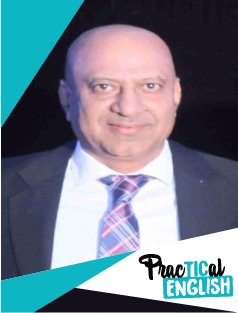
Zafar Yar Khan
Author and Publisher